


“Green circular textile” is a useful ambition, but it is not a material category and it cannot be proven by naming one fiber. A responsible textile decision considers raw-material origin, fiber production, fabric construction, chemical inputs, durability, repairability, collection, sorting, and the conditions required for end-of-life treatment. Lyocell can be an important part of that system because it is a regenerated cellulosic fiber with a soft hand, moisture absorption, and potential biodegradability under appropriate conditions. Yet it should not be presented as an automatic replacement for viscose or polyester in every product. The best choice depends on the garment or textile function, blend design, and the claims a business can actually substantiate.
Quick answer: replacement is use-case specific
Lyocell can replace viscose in some apparel, home-textile, yarn, and nonwoven applications where a regenerated cellulosic fiber is required and the desired fabric properties can be achieved with Lyocell. It can also reduce the polyester share in comfort-led blends. It is not a direct one-for-one substitute where polyester’s fast drying, abrasion resistance, heat-setting behavior, or specific mechanical role is essential. Circularity improves when the final product is designed for a defined loop, with realistic material information and an end-of-life pathway—not merely when a “green” fiber is added.
What makes a textile circular in practice?
A circular textile system seeks to keep materials useful at their highest practicable value for as long as possible, then recover or safely return them through an appropriate pathway. This requires more than selecting a renewable or biodegradable feedstock. A shirt made from a cellulosic fiber may still contain sewing thread, elastic, coatings, prints, labels, and finishes that complicate sorting or biological treatment. A recycled-content polyester textile may extend material value but still needs collection and processing systems that accept it.
For material teams, a more useful sequence is: define the product’s service life; identify the dominant performance requirement; minimize unnecessary material complexity; document composition accurately; choose trims and finishes that support the intended recovery route; and communicate end-of-life conditions without overstatement. A product designed for mechanical recycling has different constraints from one designed for controlled biodegradation. Trying to promise both without supporting design choices can create confusion rather than circular value.
Biodegradable does not mean a garment will disappear quickly in every natural environment, landfill, wastewater system, or home compost bin. Degradation depends on temperature, moisture, microorganisms, oxygen, time, fabric mass, dyes, finishes, and blend components. Therefore, businesses should use precise language such as “cellulosic fiber component” or “biodegradability to be evaluated for the finished article,” unless they hold evidence for the exact product and disposal setting.
Lyocell, viscose, and polyester: compare the system, not the label
| Decision factor | Lyocell | Viscose | Polyester |
|---|---|---|---|
| Fiber family | Regenerated cellulosic | Regenerated cellulosic | Synthetic polymer |
| Typical design value | Softness, moisture absorption, smooth hand | Softness, drape, broad textile use | Strength, fast drying, durability-oriented roles |
| Replacement question | Evaluate against end use and fabric build | May be replaced where Lyocell meets the target | May be reduced or blended where its role is not critical |
| End-of-life claim | Assess finished product and disposal conditions | Assess finished product and disposal conditions | Assess collection and recycling route; do not assume circularity |
Lyocell and viscose are both regenerated cellulosic fibers, but the appropriate selection should be tied to verified process information, fiber properties, spinning performance, fabric appearance, and the actual product brief. The viscose fiber overview on the Tasker site describes viscose as regenerated cellulose made from natural cellulose sources and highlights its moisture absorption, soft feel, dyeability, and biodegradability. Those overlapping characteristics explain why Lyocell can be considered for certain substitution projects, but they do not remove the need for side-by-side sampling.
Polyester belongs in the comparison for a different reason. It often provides strength, resilience, rapid drying, or dimensional control that an all-cellulosic fabric may not deliver in the same construction. Replacing it may be appropriate in a fluid shirt, bedding textile, or comfort-led knit; it may be less appropriate in a product with demanding abrasion, high sweat exposure, or heat-setting requirements. The responsible decision is not “natural versus synthetic,” but whether the material system achieves the intended lifespan and performance with a credible recovery plan.
When Lyocell is a credible replacement option
Lyocell is worth developing as a replacement candidate when the project needs a cellulose-based hand, good moisture absorption, smooth surface character, and a fabric that can be engineered around those strengths. Apparel shirting, soft knit tops, dresses, sleepwear, bedding components, and selected nonwoven applications may be suitable starting points. In yarn programs, Lyocell fiber for spinning can be assessed for dry and wet strength, yarn processing, hand feel, and the desired fabric appearance.
Replacement becomes less straightforward when the original material performs a demanding structural job. A woven workwear fabric, high-abrasion bag lining, compressed sportswear knit, or water-resistant outer layer may need a different construction, a blend, or a different product concept. Rather than force a material switch, define what function must be preserved and what trade-off the program is willing to accept. The questions should include: Is the target a lower synthetic content, a different fiber source, improved comfort, a simpler end-of-life composition, or a verified certification requirement? Each objective produces a different specification.
Material developers should also avoid treating fiber replacement as the end of the work. Fabric preparation, dyeing, printing, coating, sewing, and packaging can materially influence the environmental profile and recovery potential. The most useful project conversations include these downstream choices early, especially if the product will carry a circularity or biodegradability statement.
Designing for biodegradability without making false claims
A biodegradable fiber component is only one element of a biodegradable textile. Mixed materials can create different end-of-life behavior from the base fiber. Elastane, polyester sewing thread, pigment prints, water-repellent treatments, resin finishes, coatings, zippers, buttons, labels, and packaging all need to be considered. The right approach is to document the bill of materials and decide which elements are essential for service life and which can be simplified.
For a product intended to rely on cellulosic end-of-life attributes, teams should consider mono-material or low-complexity constructions where performance allows. They should also verify that claimed treatments and dyes are compatible with the intended recovery or disposal pathway. If strength, stretch, or durability requires a blend, communicate the blend honestly and avoid describing the entire article as biodegradable unless the finished product has been evaluated under relevant conditions.
Product-specific development can begin with customized Lyocell fiber options when fineness, length, luster, fibrillation behavior, or other fiber parameters must be matched to a particular yarn or fabric route. Customization is valuable only when it addresses a measurable product requirement; it should not be used to imply a sustainability outcome that has not been verified.
Read the production claim at the correct level
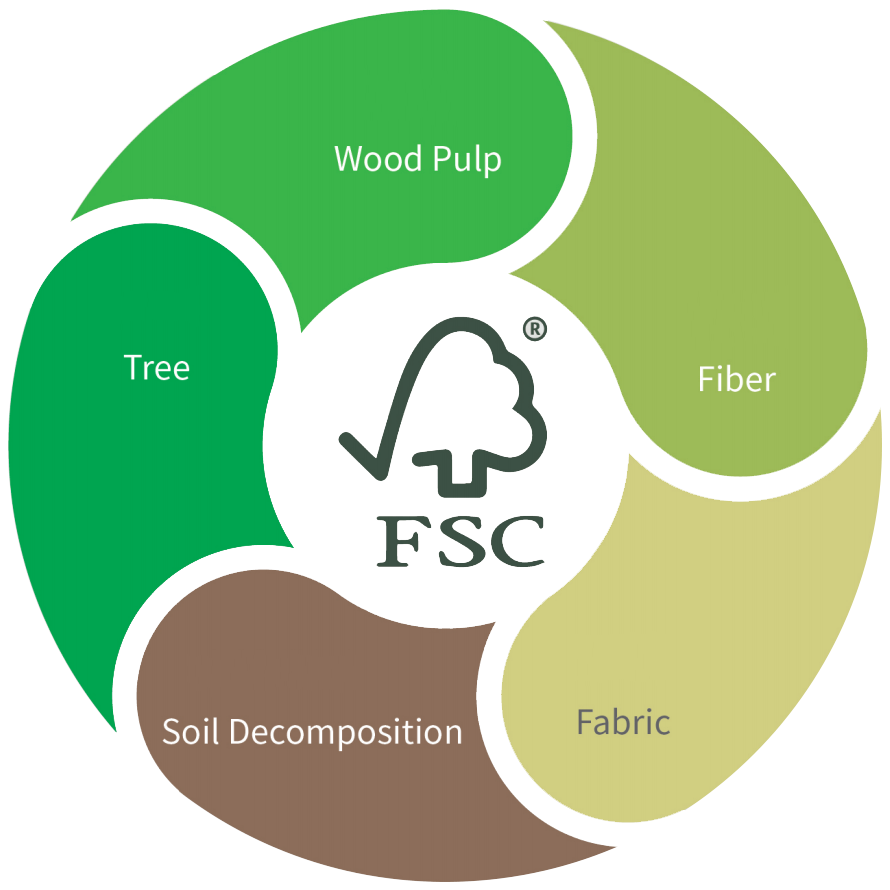
Fiber-process information can support a procurement conversation, but it cannot stand in for a complete product life-cycle assessment. On its process page, Tasker describes pulp preparation, dissolution, fiber regeneration, and its wet-process production route. The Lyocell production pathway also presents a circular-process perspective and use of sustainable forest resources. Buyers should request the exact evidence and scope needed for their market, customer requirement, or claim language.
It is helpful to separate three levels of statement. First, a fiber fact describes the supplied fiber itself. Second, a fabric claim describes a tested fabric construction and its composition. Third, a finished-product claim includes every material and process used in the article. These levels should not be blended. A claim that is accurate for a Lyocell staple fiber may be inaccurate for a dyed, coated, multi-fiber garment with synthetic trims.
Questions to ask before changing the fiber system
- What function does the current viscose or polyester perform in the finished textile?
- Which result matters most: hand feel, strength, moisture behavior, shrinkage control, drying, appearance, price, or end-of-life compatibility?
- Can the garment be simplified into fewer material types without compromising safe or intended use?
- Which fiber, fabric, and finished-product facts are backed by current documents or testing?
- What collection, sorting, recycling, industrial composting, or other disposal route is realistically available in the target market?
Tasker’s Tasker company profile identifies a Lyocell production operation and differentiated fiber development. Xuzhou Tasker Import and Export Co., Ltd. can be considered as a manufacturer option when a buyer’s request defines the end use, relevant fiber characteristics, and the evidence needed for subsequent textile claims.
Conclusion
Lyocell can support a green circular textile strategy, but only when its role is matched to a complete product design. It may replace viscose where desired hand, strength, processing, and cost targets are met, and it may reduce polyester where synthetic performance is not indispensable. It cannot automatically make a complex garment circular or biodegradable. The stronger approach is to test the proposed fiber system, simplify the bill of materials where possible, state claims at the correct level, and plan an achievable end-of-life route. Tasker, a Lyocell fiber manufacturer, is most relevant to programs that turn those principles into clear fiber and fabric specifications.
FAQs
Can Lyocell replace viscose?
Lyocell can be a replacement candidate in applications where the needed yarn, fabric, hand feel, strength, dyeing response, and cost can be met. It should be sampled and evaluated against the exact product specification.
Can Lyocell replace polyester in all textiles?
No. Polyester may be essential for particular durability, rapid-drying, heat-setting, or structural requirements. Lyocell can be used alone or in blends when the end use permits the required trade-offs.
Is Lyocell a biodegradable textile?
Lyocell is a cellulosic fiber with biodegradability potential, but a finished textile may contain other fibers, dyes, coatings, trims, and finishes. Evaluate the completed article and the actual disposal conditions before making a broad claim.
What does green circular textile mean?
It describes a textile strategy aimed at reducing resource loss through longer use, responsible material choices, accurate composition information, and a viable recovery or safe return route. It is not a certification or a single-fiber guarantee.
What evidence is needed for a circularity claim?
The needed evidence depends on the claim and market, but commonly includes accurate composition records, process documents, applicable certifications, testing for the finished article, and a credible description of the intended end-of-life route.


